
Just before the 2008 financial crisis made headlines, Indian companies were on a global buying spree. In the fifth part of the series, Dev Chatterjee and Krishna Kant discuss how the crisis came as a black swan event for some, changing the mood from exuberance to despair.

A weaker rupee could aid corporate earnings through its positive impact on export intensive sectors such as information technology services, pharmaceuticals and commodity producers such as metal and mining, and oil and gas companies.

HUL, ITC, Nestle, Colgate, Dabur, Britannia, Asian Paints, P&G are trading at nearly 48 times. The previous record high was 53 times at the end of March 1994.

'Aleris will bring in $3 billion of revenue. Novelis has $12 billion of revenues. If we add Hindalco's $6-billion revenue, then on a consolidated basis, we will become the world's largest aluminium company outside China.'
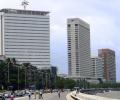
Built in 1974, the building could fetch anywhere between Rs 1,000 crore to Rs 1,500 crore, based on current real estate prices

On the other hand, the group's two traditional cash cows, TCS and Tata Motors' subsidiary Jaguar Land Rover, are slowing as other businesses pick up pace

The combined assets of the top five - Tata Consultancy Services (TCS), Infosys Technologies, Wipro, HCL Technologies and Tech Mahindra were down one per cent to Rs 27,7400 crore at the end of 2017-18, from Rs 28,0100 crore a year before.

The brand image, however, may not tarish further as it will have already taken the beating due to consistent injury

According to industry experts, companies in sectors such as consumer durables (fans, air-conditioners), power cables and the electrical industry will be hit, given that they are big users of copper.

Flipkart will need $2 bn annual profit to make Walmart investment viable, which will mean yearly revenue of $100 bn

Did top Indian business groups miss the e-commerce opportunity by focusing on replicating the Walmart model instead of following the Amazon model of online shopping?

IT major nears $100 bn m-cap, accounts for 61% of the group's combined valuation.
Centre took Rs 1,002 bn from here in 2017-18, sharply up from Rs 904 bn a year before and Rs 123.6 bn in FY14

With a loan book of $268 billion, India's retail banking is now ahead of Russia, Malaysia and Mexico but behind China, Brazil and Thailand

The merged entity would lead with a revenue market share of about 37 per cent against Airtel's 31.2 per cent and Jio's 14.5 per cent
Rising oil prices and diminishing cash pile to limit capacity in 2018-19

Investors turn their attention to export-driven sectors.

A financial turnaround in Tata Steel and Tata Motors has come as a shot in the arm for Chandra.
After years of losing money on two of the group's biggest bets - global steel business and domestic passenger cars - there are strong signs of a revival in both businesses.

The problem is actually acute in the diamond jewellery industry where there is no uniform criteria of inventory valuation unlike gold, whose prices are uniform and widely quoted.
 © 2026 Rediff.com - Advertise with us - Disclaimer - Privacy Policy - Sitemap - Feedback - About us - Terms of use - Grievances